
Resources are the additional files and static content that your code uses, such as bitmaps, user interface strings, animation instructions, and more.
Always externalize app resources such as images and strings from your code, so that you can maintain them independently. Also, provide alternative resources for specific device configurations by grouping them in specially named resource directories. At runtime, Android uses the appropriate resource based on the current configuration. For example, you might want to provide different strings depending on the language setting.
Once you externalize your app resources, you can access them
using resource IDs that are generated in your project's R class.
This document shows you how to group the resources in your Android project. It also shows you how
to provide alternative resources for specific device configurations and then access them from
your app code or other XML files.
Group resource types
Place each type of resource in a specific subdirectory of your project's
res/ directory. For example, here's the file hierarchy for a simple project:
MyProject/
    src/
        MyActivity.kt
    res/
        drawable/
            graphic.png
        mipmap/
            icon.png
        values/
            strings.xml
The res/ directory contains all the resources in its
subdirectories: an image resource, a mipmap/ directory for launcher
icons, and a string resource file. The resource
directory names are important and are described in Table 1.
Note: For more information about using the mipmap folders, see Put app icons in mipmap directories.
Table 1. Resource directories
supported inside project res/ directory.
| Directory | Resource Type |
|---|---|
drawable/ |
Bitmap files (PNG,
For more information, see Drawable resources. |
mipmap/ |
Drawable files for different launcher icon densities. For more information on managing
launcher icons with mipmap/ folders, see
Put app icons in
mipmap directories. |
raw/ |
Arbitrary files to save in their raw form. To open these resources with a raw
However, if you need access to the original filenames and file hierarchy, consider
saving resources in the |
values/ |
XML files that contain simple values, such as strings, integers, and colors. Whereas XML resource files in other Because each resource is defined with its own XML element, you can name the file whatever you want and place different resource types in one file. However, for clarity, you might want to place unique resource types in different files. For example, here are some filename conventions for resources you can create in this directory:
For more information, see String resources, Style resource, and More resource types. |
xml/ |
Arbitrary XML files that can be read at runtime by calling Resources.getXML. Various XML configuration files
must be saved here.
|
font/ |
Font files with extensions such as TTF, OTF,
or TTC, or XML files that
include a <font-family> element. For more information about
fonts as resources, see
Add a font as an XML resource.
|
Caution: Never save resource files directly inside the
res/ directory. It causes a compiler error.
The resources that you save in the subdirectories defined in Table 1 are your default resources. That is, these resources define the default design and content for your app. However, different types of Android-powered devices might call for different types of resources.
For example, you can provide different string resources that translate the text in your user interface based on the device's language setting.
Note: In Compose, UIs, animations, and state-driven colors are declared in Kotlin, so the
layout/, menu/, anim/, animator/,
and color/ directories are obsolete for modern apps. For more
information, see Animations in
Compose and Anatomy of a theme
in Compose.
Provide alternative resources
Most apps provide alternative resources to support specific device configurations. For instance, include alternative drawable resources for different screen densities and alternative string resources for different languages. At runtime, Android detects the current device configuration and loads the appropriate resources for your app.
To specify configuration-specific alternatives for a set of resources, do the following:
- Create a new directory in
res/named in the form<resources_name>-<qualifier>.<resources_name>is the directory name of the corresponding default resources (defined in Table 1).<qualifier>is a name that specifies an individual configuration for which these resources are to be used (defined in Table 2).
You can append more than one
<qualifier>. Separate each one with a dash.Caution: When appending multiple qualifiers, you must place them in the same order in which they are listed in Table 2. If the qualifiers are ordered incorrectly, the resources are ignored.
- Save the appropriate alternative resources in this new directory. The resource files must be named exactly the same as the default resource files.
For example, here are some default and alternative resources:
res/
    drawable/
        icon.png
        background.png
    drawable-hdpi/
        icon.png
        background.png
The hdpi qualifier indicates that the resources in that directory are for devices with a
high-density screen. The images in these drawable directories are sized for specific
screen densities, but the filenames are exactly
the same. This way, the resource ID that you use to reference the icon.png or
background.png image is always the same. Android selects the
version of each resource that best matches the current device by comparing the device
configuration information with the qualifiers in the resource directory name.
Caution: When defining an alternative resource, make sure you
also define the resource in a default configuration. Otherwise, your app might encounter runtime
exceptions when the device changes a configuration. For example, if you add a string to only
values-en and not values, your app might encounter a
Resource Not Found exception when the user changes the default system language.
Table 2 lists configuration qualifiers in order of precedence. You can add multiple qualifiers to one directory name by separating each qualifier with a dash. If you use multiple qualifiers for a resource directory, you must add them to the directory name in the order they are listed in the table.
Table 2. Configuration qualifier names.
| Configuration | Qualifier values | Description |
|---|---|---|
| MCC and MNC | Examples:mcc310mcc208-mnc00
|
The mobile country code (MCC), optionally followed by the mobile network code (MNC)
from the SIM card in the device. For example, If the device uses a radio connection (that is, it's a GSM phone), the MCC and MNC values come from the SIM card. You can also use the MCC alone, for example, to include country-specific legal resources in your app. If you need to specify based on the language only, then use the language, script (optional), and region (optional) qualifier instead. If you use the MCC and MNC qualifier, do so with care and test that it works as expected. Also see the configuration fields |
| Language, script (optional), and region (optional) | Examples:enfren-rUSfr-rFRfr-rCAb+enb+en+USb+es+419b+zh+Hantb+sr+Latn+RS |
The language is defined by a two-letter ISO 639-1 language code, optionally followed
by a two-letter ISO 3166-1-alpha-2 region code (preceded by
lowercase The codes are not case-sensitive. The Android 7.0 (API level 24) introduced support for BCP 47 language tags, which you can use to qualify language- and region-specific resources. A language tag is composed from a sequence of one or more subtags, each of which refines or narrows the range of language identified by the overall tag. For more information about language tags, see Tags for Identifying Languages. To use a BCP 47 language tag, concatenate The language tag can change during the life of your app if users change their language in the system settings. For information about how this can affect your app during runtime, see Handle configuration changes. For a complete guide to localizing your app for other languages, See Localize your app. Also see the |
| Grammatical gender | masculinefeminineneuter |
The user's grammatical gender. Used for languages that have grammatical gender. For example, if you need to provide different resources for French speaking users, then you can use directories like the following:
See Personalize your app's UI with grammatical gender. Also see the Added in API level 34. |
| Wide Color Gamut |
widecgnowidecg
|
Added in API level 26. Also see the |
| High Dynamic Range (HDR) |
highdrlowdr
|
Added in API level 26. Also see the |
| UI mode |
cardesktelevisionappliancewatchvrheadset
|
Added in API level 8; television added in API 13; appliance added in API 16; watch added in API 20; vrheadset added in API 26. For information about how your app can respond when the device is inserted into or removed from a dock, read Determine and monitor the docking state and type. This can change during the life of your app if the user places the device in a
dock. You can enable or disable some of these modes using
|
| Night mode |
nightnotnight
|
Added in API level 8. This can change during the life of your app if night mode is left in
auto mode (default), in which case the mode changes based on the time of day. You can enable
or disable this mode using |
| Screen pixel density (dpi) |
ldpimdpihdpixhdpixxhdpixxxhdpinodpitvdpianydpinnndpi
|
There is a 3:4:6:8:12:16 scaling ratio between the six primary densities (ignoring the tvdpi density). So, a 9x9 bitmap in ldpi is 12x12 in mdpi, 18x18 in hdpi, 24x24 in xhdpi, and so on. Note: Using a density qualifier doesn't imply that the resources are only for screens of that density. If you don't provide alternative resources with qualifiers that better match the current device configuration, the system uses whichever resources are the best match. For more information about how to handle different screen densities and how Android might scale your bitmaps to fit the current density, see Screen compatibility overview. |
| Touchscreen type |
notouchfinger
|
Also see the |
| Keyboard availability |
keysexposedkeyshiddenkeyssoft
|
If you provide This can change during the life of your app if the user opens a hardware keyboard. For information about how this affects your app during runtime, see Handle configuration changes. Also see the configuration fields |
| Primary text input method |
nokeysqwerty12key
|
Also see the |
| Navigation key availability |
navexposednavhidden
|
This can change during the life of your app if the user reveals the navigation keys. For information about how this affects your app during runtime, see Handle configuration changes. Also see the |
| Primary non-touch navigation method |
nonavdpadtrackballwheel
|
Also see the |
| Platform version (API level) | Examples:v3v4v7etc. |
The API level supported by the device. For example, |
Note: Not all versions of Android support all the qualifiers. Using a new qualifier implicitly adds the platform version qualifier so that older devices can ignore it. To avoid any issues, always include a set of default resources (a set of resources with no qualifiers). For more information, see the section about providing the best device compatibility with resources.
In Compose apps, layout- and dimension-related configuration qualifiers aren't needed. While they still exist, they are excluded from Table 2. These qualifiers include: layout direction, smallest width, available width, available height, screen size, screen aspect, round screen, and screen orientation. For the full table of configuration qualifiers in order of precedence, see App resources overview (Views).
Qualifier name rules
Here are some rules about using configuration qualifier names:
- You can specify multiple qualifiers for a single set of resources, separated by dashes. For
example,
drawable-en-rUS-nightapplies to US-English devices in night mode. - The qualifiers must be in the order listed in Table 2.
- Wrong:
drawable-hdpi-night/ - Correct:
drawable-night-hdpi/
- Wrong:
- Alternative resource directories can't be nested. For example, you can't have
res/drawable/drawable-en/. - Values are case-insensitive. The resource compiler converts directory names to lowercase before processing to avoid problems on case-insensitive file systems. Any capitalization in the names is only to benefit readability.
- Only one value for each qualifier type is supported. For example, if you want to use
the same drawable files for Spain and France, you can't have a directory named
drawable-es-fr/. Instead, you need two resource directories, such asdrawable-es/anddrawable-fr/, which contain the appropriate files.
After you save alternative resources into directories named with these qualifiers, Android automatically applies the resources in your app based on the current device configuration. Each time a resource is requested, Android checks for alternative resource directories that contain the requested resource file, then finds the best-matching resource.
If there are no alternative resources that match a particular device configuration, then Android uses the corresponding default resources—the set of resources for a particular resource type that doesn't include a configuration qualifier.
Create alias resources
When you have a resource that you'd like to use for more than one device configuration but you don't want to provide it as a default resource, you don't need to put the same resource in more than one alternative resource directory. Instead, you can create an alternative resource that acts as an alias for a resource saved in your default resource directory.
Drawables
For example, imagine you have an app icon, icon.png, and need a unique version of
it for different locales. However, two locales, English-Canadian and French-Canadian, need to
use the same version. You don't need to copy the same image
into the resource directory for both English-Canadian and French-Canadian.
Instead, you can save the image that's used for both using any name other than
icon.png, such as icon_ca.png, and put
it in the default res/drawable/ directory. Then create an icon.xml file in
res/drawable-en-rCA/ and res/drawable-fr-rCA/ that refers to the icon_ca.png
resource using the <bitmap> element.
<?xml version="1.0" encoding="utf-8"?>
<bitmap xmlns:android="http://schemas.android.com/apk/res/android" android:src="@drawable/icon_ca" />
This lets you store just one version of the
PNG file and two small XML files that point to it.
Then you can use painterResource(R.drawable.icon) and the system will pick the
appropriate file once it detects the locale.
Strings and other simple values
To create an alias to an existing string, use the resource ID of the desired string as the value for the new string:
<?xml version="1.0" encoding="utf-8"?>
<resources>
    <string name="hello">Hello</string>
    <string name="hi">@string/hello</string>
</resources>
The R.string.hi resource is now an alias for the R.string.hello.
Other simple values work the same way, such as colors:
<?xml version="1.0" encoding="utf-8"?>
<resources>
    <color name="red">#f00</color>
    <color name="highlight">@color/red</color>
</resources>
Access your app resources
Once you provide a resource in your application, you can apply it by
referencing its resource ID. All resource IDs are defined in your project's R class, which
the aapt tool automatically generates.
When your application is compiled, aapt generates the R class, which contains
resource IDs for all the resources in your res/ directory. For each type of resource,
there is an R subclass, such as
R.drawable for all drawable resources. And for each resource of that type, there is a
static integer, for example, R.drawable.icon. This integer is the resource ID that you can use
to retrieve your resource.
Although the R class is where resource IDs are specified, you don't need to
look there to discover a resource ID. A resource ID is always composed of the following:
- The resource type: each resource is grouped into a "type," such as
stringordrawable. - The resource name, which is the filename excluding the extension.
Access resources in Compose
Jetpack Compose provides built-in, composable-aware functions to access resources securely.
- Strings:
stringResource(id = R.string.hello)
- Drawables:
painterResource(id = R.drawable.my_icon)
Access resources in non-UI code
If you need to access resources outside of your UI hierarchy—such as in a
ViewModel, a Repository, or a system Service—you can
resolve them using the Context.
// Retrieve a localized string resource
val greeting = context.getString(R.string.hello_world)
You can also retrieve individual resources using methods in Resources, which you can get an instance of
with getResources.
Syntax
Here's the syntax to reference a resource in code:
[<package_name>.]R.<resource_type>.<resource_name>
<package_name>is the name of the package in which the resource is located (not required when referencing resources from your own package).<resource_type>is theRsubclass for the resource type.<resource_name>is either the resource filename without the extension or theandroid:nameattribute value in the XML element, for simple values.
For more information about each resource type and how to reference them, see Resources in Compose.
Access original files
While uncommon, you might need to access your original files and directories. If you do, then
saving your files in res/ won't work for you, because the only way to read a resource from
res/ is with the resource ID. Instead, you can save your resources in the
assets/ directory.
Files saved in the assets/ directory are not given a resource
ID, so you can't reference them through the R class or from XML resources. Instead, you can
query files in the assets/ directory like a normal file system and read raw data using
AssetManager.
However, if all you require is the ability to read raw data (such as a video or audio file),
then save the file in the res/raw/ directory and read a stream of bytes using
openRawResource.
Access platform resources
Android contains a number of standard resources, such as system styles and themes. To access
these, qualify your resource reference with the android package class. For example:
painterResource(android.R.drawable.ic_menu_info_details).
Provide the best device compatibility with resources
For your app to support multiple device configurations, it's very important that you always provide default resources for each type of resource that your app uses.
For example, if your app supports several languages, always include a values/ directory (in which your strings are saved) without a language and region qualifier. If you instead put all your string files
in directories that have a language and region qualifier, then your app crashes when run
on a device set to a language that your strings don't support.
As long as you provide default
values/ resources, then your app runs properly, even if the user doesn't
understand the language it presents. It's better than crashing.
Providing default resources is important not only because your app might run on a configuration you hadn't anticipated, but also because new versions of Android sometimes add configuration qualifiers that lower versions don't support. If you use a new resource qualifier, but maintain code compatibility with lower versions of Android, then when a lower version of Android runs your app, it crashes if you don't provide default resources, because it can't use the resources named with the new qualifier.
For example, if your minSdkVersion is set to 4, and you qualify all of your drawable resources using night mode (night or notnight, which were added in API
level 8), then an API level 4 device can't access your drawable resources and crashes. In this
case, you probably want notnight to be your default resources, so exclude that
qualifier and put your drawable resources in either drawable/ or drawable-night/.
In short, to provide the best device compatibility, always provide default resources for the resources your app needs to perform properly. Then create alternative resources for specific device configurations using configuration qualifiers.
There is one exception to this rule: If your app's minSdkVersion is 4 or
greater, you don't need default drawable resources when you provide alternative drawable
resources with the screen density qualifier. Even without default
drawable resources, Android can find the best match among the alternative screen densities and scale
the bitmaps as necessary. However, for the best experience on all types of devices,
provide alternative drawables for all three types of density.
How Android finds the best-matching resource
When you request a resource for which you provide alternatives, Android selects which alternative resource to use at runtime, depending on the current device configuration. To demonstrate how Android selects an alternative resource, assume the following drawable directories each contain different versions of the same images:
drawable/
drawable-en/
drawable-fr-rCA/
drawable-en-night/
drawable-en-notouch-12key/
drawable-night-ldpi/
drawable-night-notouch-12key/
And assume the following is the device configuration:
Locale = en-GB
Night mode = night
Screen pixel density = hdpi
Touchscreen type = notouch
Primary text input method = 12key
By comparing the device configuration to the available alternative resources, Android selects
drawables from drawable-en-night.
The system arrives at its decision for which resources to use with the following logic:
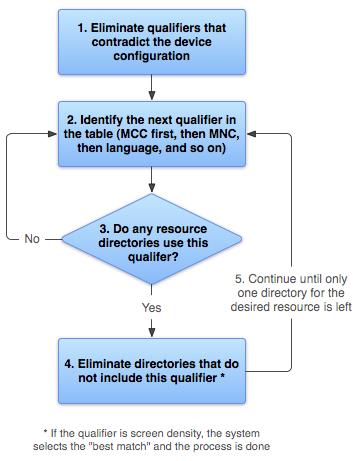
Figure 2. Flowchart of how Android finds the best-matching resource.
- Eliminate resource files that contradict the device configuration.
The
drawable-fr-rCA/directory is eliminated, because it contradicts theen-GBlocale.drawable/ drawable-en/
drawable-fr-rCA/drawable-en-night/ drawable-en-notouch-12key/ drawable-night-ldpi/ drawable-night-notouch-12key/Exception: Screen pixel density is the one qualifier that is not eliminated due to a contradiction. Even though the screen density of the device is hdpi,
drawable-night-ldpi/isn't eliminated because every screen density is considered to be a match at this point. For information, see Screen compatibility overview. - Find the next-highest-precedence qualifier in the list (Table 2). (Start with MCC.)
- Do any of the resource directories include this qualifier?
- If no, return to step two and look at the next qualifier. In this example, the answer is "no" until the language qualifier is reached.
- If yes, continue to step four.
- Eliminate resource directories that don't include this qualifier. In this example, the system
next eliminates all the directories that don't include a language qualifier:
drawable/drawable-en/ drawable-en-night/ drawable-en-notouch-12key/drawable-night-ldpi/drawable-night-notouch-12key/Exception: If the qualifier in question is screen pixel density, Android selects the option that most closely matches the device screen density. In general, Android prefers scaling down a larger original image to scaling up a smaller original image. For more information, see Screen compatibility overview.
- Repeat steps two, three, and four until only one directory remains. In this example, night
mode is the next qualifier for which there are any matches.
So, resources that don't specify night mode are eliminated:
drawable-en/drawable-en-night/drawable-en-notouch-12key/The remaining directory is
drawable-en-night.
Though this procedure is executed for each resource requested, the system optimizes some aspects of it. One such optimization is that once the device configuration is known, it might eliminate alternative resources that can never match. For example, if the configuration language is English, then any resource directory that has a language qualifier set to something other than English is never included in the pool of resources checked (though a resource directory without the language qualifier is still included).
When selecting resources based on the screen size qualifiers, the system uses resources designed for a screen smaller than the current screen if there are no resources that better match. For example, a large-size screen uses normal-size screen resources if necessary.
However, if
the only available resources are larger than the current screen, the system
doesn't use them and your app crashes if no other resources match the device
configuration. This happens, for example, if all layout resources are tagged with the xlarge qualifier,
but the device is a normal-size screen.
Note: The precedence of the qualifier (in Table 2) is more important
than the number of qualifiers that exactly match the device. In the preceding example, at step four
the last choice on the list includes three qualifiers that exactly match the device (night mode,
touchscreen type, and input method), while drawable-en has only one parameter that matches
(language). However, language has a higher precedence than these other qualifiers, so
drawable-night-notouch-12key is eliminated.
Additional resources
To learn more about app resources, see the following additional resources: