

Audio glasses and display glasses use the standard Android notification
framework, so you can notify users across different form factors using the same
notification APIs. To promote maximum compatibility and minimize development
overhead, use the Android NotificationCompat APIs. Android parses
incoming notifications and adapts their presentation based on the capabilities
of the device.
By following the best practices for notifications, your existing phone notifications can be bridged to audio glasses and display glasses with little to no additional configuration. Read the information in the following sections to understand how the system adapts notifications for audio glasses and display glasses.
How the system determines whether to bridge a notification
Android uses the incoming notification's Notification.Style together with
several other criteria to determine whether or not to bridge the notification to
the user's audio glasses or display glasses.
Supported notification styles
Audio glasses and display glasses support a subset of Android
Notification.Style classes. The following notification styles are fully
rendered on display glasses:
Standard style (
NotificationCompat.Style)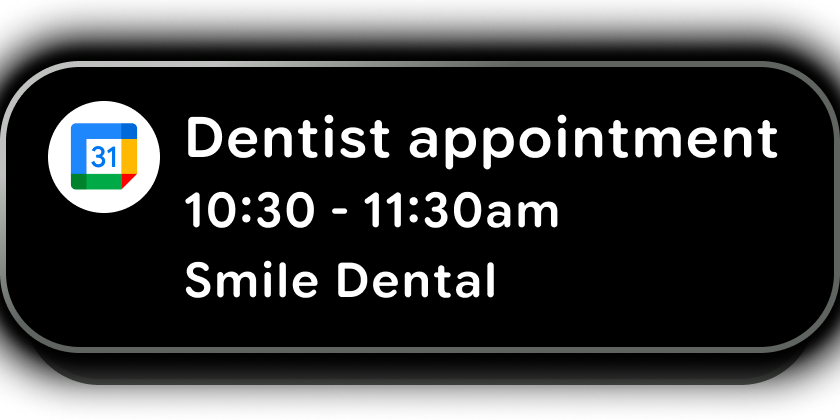
-

-

CallStyle(only when the notification qualifies as a live update)
Other notification styles (such as InboxStyle) aren't fully parsed and
rendered. For these styles, style-specific fields aren't rendered (such as the
summary text for InboxStyle). Instead, the system reverts to the
standard style and renders only common fields such as the content title.
Other required criteria for bridging
Besides the notification's style, a notification must also meet the following criteria to be bridged to the user's audio glasses or display glasses:
- The notification isn't subject to any of the following user-controlled
settings that would prevent its delivery:
Glasses companion app settings:
App-level toggle: By default, app notifications are toggled off in the Glasses app to help users purposefully decide which notifications are bridged to their glasses.
This default behavior lets a user leave notifications enabled on their phone for a certain app, but disable them for that app on their glasses. To help a user decide whether to enable notifications for your app in the Glasses app, explain how notifications would improve their experience with your app.
System-level notification settings on the user's phone:
App-level toggle: If a user disables notifications entirely for an app on the phone, no notifications for that app are bridged.
Notification channel settings: If a user disables notifications for an app-defined notification channel, no notifications for that channel are bridged.
System-level Do Not Disturb (DND) settings on the user's phone: AI glasses use the phone's DND settings. If the user's phone is in DND mode, notifications are also suppressed on the user's glasses.
- The notification is assigned to a channel with
IMPORTANCE_HIGHorIMPORTANCE_MAX. - The notification's title isn't
nullor empty. - The notification isn't marked with
FLAG_LOCAL_ONLY. If this flag is set, the notification is restricted to the primary device. - The notification isn't an ongoing notification, such as a persistent background task, unless it qualifies as a Live Update notification.
How Live Update notifications are bridged to display glasses
Live Update notifications are a specialized class of notifications designed for ongoing, user-initiated activities that require real-time monitoring, such as rideshare ETAs, turn-by-turn navigation, or active calls. Unlike regular notifications, live updates remain active to provide a continuous stream of information that are surfaced prominently across the system UI.
For display glasses, live updates are rendered in two primary locations:
- Home screen: Live Update notifications appear on the Home canvas as cards. If multiple live updates are active, the system uses a stack instead.
- System bar: When the user is inside another app or experience, live updates appear as status chips in the system bar. These chips appear briefly whenever a status change occurs. If the display is asleep, a status chip automatically wakes the screen to signal a status change, so the user stays informed without manual interaction.
If a live update notification uses a supported notification style for AI
glasses, it is fully parsed and rendered. Live Updates notifications that use
other notification styles (such as BigTextStyle) aren't fully parsed,
and the system adapts them to a standard style notification instead.
Available notification actions for display glasses
On display glasses, incoming notifications appear as
heads-up notifications (HUNs). For MessagingStyle notifications, your
app can use a direct reply action. Users can tap to expand for more
details and reply. For all other notification styles, the only available option
is the system-provided clear action.
When using direct reply, users can reply with the voice or select from a smart reply list by scrolling forward. For smart replies, you can use our on-device AI to suggest short, relevant replies.